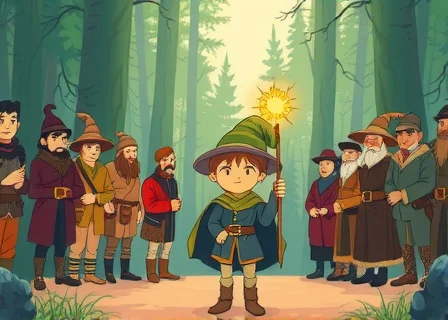
The Wand That Only Worked for Good
# The Wand That Only Worked for Good
Once upon a time, in a kingdom nestled between whispering mountains and a sea that sparkled like crushed diamonds, there lived a young wizard named Elian. Unlike other wizards who studied for decades in towering academies, Elian had learned his craft from an ancient oak tree that spoke in riddles and rustling leaves.
One autumn morning, the oak tree gifted Elian a wand carved from its own branch. "This wand," the tree creaked, "holds extraordinary power. But remember this, young wizard: it shall only work for good."
Elian accepted the wand gratefully, admiring its smooth surface and the gentle warmth that pulsed through its wood. He set out into the world eager to prove himself a great wizard.
His first test came swiftly. In the village of Brambleton, a cruel merchant was cheating poor farmers, taking their grain and giving them empty promises in return. Anger flared in Elian's chest. He raised his wand, ready to teach the merchant a lesson with a fearsome spell.
But the wand remained cold and silent.
Confused, Elian tried again. Still nothing. The merchant laughed and continued his dishonest dealings. Frustrated, Elian left the village, the wand dangling uselessly in his hand.
Days passed, and Elian encountered more troubles: a family turned out of their home, a child lost in the forest, an elderly woman too weak to fetch water. Each time, Elian helped them—not with magic, but with his own two hands and a kind heart. He worked alongside the family to rebuild their cottage, searched through the night until he found the crying child, and carried water until his arms ached.
Slowly, Elian began to understand.
When bandits attacked a traveling caravan, Elian didn't reach for his wand to strike them down. Instead, he stood between the weapons and the merchants, speaking words of peace and offering the bandits honest work. Something remarkable happened: as Elian spoke from genuine compassion, his wand began to glow.
Light erupted from its tip, not as a weapon, but as a bridge of golden energy that connected every person present. The bandits felt the hunger of those they had robbed. The merchants understood the desperation that drove honest people to crime. Weapons fell to the ground as tears replaced anger.
That night, Elian sat by the fire, finally comprehending the wand's true nature. It wasn't that the wand refused to work—it was that it demanded he work *with* it, not *through* it. The magic flowed only when his intentions were pure, when his heart sought to heal rather than harm, to lift up rather than tear down.
Years later, Wizard Elian became known throughout the land not for spectacular displays of power, but for the quiet miracles that followed him: crops that flourished, feuds that ended, broken spirits that mended. Children would ask to see the famous wand, expecting something magnificent.
They were always surprised by its simple appearance.
"How does it work?" they'd ask.
Elian would smile, his eyes holding the wisdom of countless good deeds. "The wand doesn't make you good, little one. You must already be good for the wand to work at all."
And in a world full of shortcuts and easy answers, that remained the most powerful magic of all.