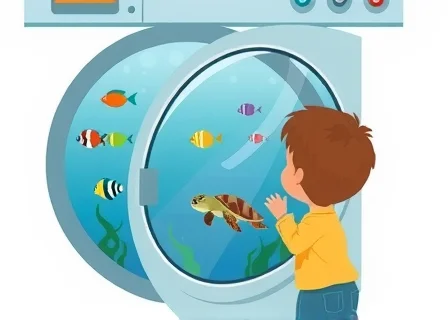
The Washing Machine That Was a Portal to the Sea
Once upon a time, in a small coastal village nestled between rolling hills and the endless blue horizon, there lived a young girl named Marina who discovered something extraordinary in her grandmother's laundry room.
It was an old washing machine, white as sea foam, with a round glass door that seemed to shimmer even in the dimmest light. Her grandmother had always warned her never to open it during the spin cycle, but one stormy afternoon, curiosity got the better of Marina.
As the machine whirred and churned, Marina pressed her ear against its metal shell. Instead of the expected mechanical hum, she heard something impossible—the crashing of waves, the cry of seagulls, and the distant song of whales. Her heart pounding, she opened the glass door.
Inside, there were no drums or paddles, only swirling water that sparkled like liquid sapphire. Without thinking, Marina reached her hand inside. The water was warm and salty, and suddenly, she felt something grasp her fingers. A small crab, no bigger than her thumb, pinched gently before scuttling deeper into the watery vortex.
That night, Marina returned with a flashlight and an empty bucket. She opened the washing machine wider and peered inside. What she saw took her breath away. Through the circular portal, she could see an entire underwater kingdom—coral castles, schools of iridescent fish, and merfolk dancing in currents that glowed with bioluminescence.
A young merboy appeared at the threshold, his tail shimmering silver and green. "You're the first surface-dweller to find us in three hundred years," he said, his voice bubbling like water over stones. "Our world is dying. The pollution from above has reached even our deepest trenches."
Marina spent the following weeks becoming the bridge between two worlds. She would climb into the washing machine (which was surprisingly spacious once you committed to the leap) and emerge in the underwater kingdom, which the merfolk called Aquatoria. She learned their language, their customs, and their desperate struggle against the rising tides of human carelessness.
In return, the merfolk showed Marina wonders beyond imagination. They taught her to communicate with dolphins, to harvest light from glowing plankton, and to understand the ancient songs that whales sang to navigate the oceans.
But the greatest gift came on Marina's sixteenth birthday. The Mer-Queen herself presented the girl with a pearl that glowed from within. "This pearl contains the memory of the sea," the Queen explained. "Show it to your people. Let them see what they stand to lose."
Marina returned to the surface and organized village meetings, showing the pearl's visions to anyone who would listen. Slowly, change began to happen. The village banned single-use plastics. Fishermen adopted sustainable practices. Children learned to respect the ocean as a living, breathing entity.
Years passed, and Marina never stopped visiting Aquatoria through her magical washing machine. She became known as the Tide-Walker, the human who carried the sea's voice to land. And though the washing machine eventually wore out, its metal rusting beyond repair, the portal it had created remained—not in any object, but in the hearts of those who learned to listen.
For Marina discovered that the greatest magic wasn't in crossing between worlds, but in helping two worlds understand they were never truly separate. The sea and the land, like the washing machine's endless spin, were part of one great cycle, forever connected, forever dependent on each other's care.
And if you ever find yourself by the shore, listening closely to the waves, you might just hear Marina's story whispered in the salt spray—a reminder that magic exists wherever we choose to protect the wonder of our world.