The Whale’s Journey to the Frozen Island
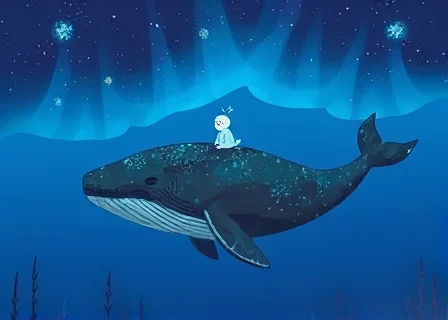
Far beyond the edges of every map, where the sea turns the color of bruised plums and the sky hums with forgotten melodies, there lived a great whale named Orune. Her back was dark as midnight basalt, and upon it bloomed barnacles that glowed like scattered constellations. The other sea creatures whispered that Orune was not merely a whale but a keeper of ancient tides — one who carried the memories of the ocean in the hollow of her vast heart.
For centuries, Orune swam the warm currents in gentle circles, singing the same low, rumbling songs her ancestors had sung since the world was new. But one evening, as the sun melted into the horizon like a coin dropped into honey, a new sound reached her — a thin, crystalline chime, fragile as frost, drifting from the far north.
It called to her in a language she did not know yet somehow understood.
That night, Orune turned north.
The sea grew colder with every league. Schools of silver fish scattered from her path, and the water turned thick with ice that cracked against her skin like shattering glass. The warm coral reefs gave way to jagged kelp forests, and the kelp forests gave way to an endless, aching blue. Still, the chime pulled her onward, threading through her songs and rewriting them.
On the twentieth day, she saw it rising from the mist — an island of ice, towering and luminous, carved by wind into spires and arches that gleamed like crystal. It was beautiful and terrible, glowing with a pale inner fire. And from its heart came the sound, clearer now: not a chime at all, but a voice.
Orune swam to the edge of the frozen shore and rested her great head upon the ice.
From a cavern in the glacier emerged a figure small enough to fit in the palm of a hand — a spirit of frost, translucent and shimmering, with eyes like winter stars. "You came," the spirit whispered, its breath a flurry of snow. "I began to think the warm seas had made you forgetful."
Orune blinked, slow and deliberate. *What is your name?* she asked in the old way, projecting thought through water and bone.
"I am called Ysvel," the spirit replied. "I am the last of the ice singers. Long ago, our voices held the glaciers in balance. But one by one, my kin fell silent. Without their song, the frozen island drifts, untethered. I have been calling for a keeper of the tides to carry me to the heart of the ocean, where the first warmth still lives. Only there can I learn the song that will restore what is breaking."
Orune understood. She had heard the world shifting, groaning, losing pieces of itself. She had felt it in her bones.
*Then let us go,* she said.
Ysvel stepped onto Orune's back, small feet finding purchase between the glowing barnacles. With a mighty sweep of her tail, the whale pushed away from the frozen island, and together they turned south.
They traveled through storms that lashed the sea into white fury, through nights so dark the stars seemed to drown, through waters so still they mirrored the heavens perfectly. Ysvel taught Orune fragments of ice songs, and Orune wove them into her ancient melodies. Wherever they passed, the waters cooled and calmed. Lost ships found their bearings by the light of Orune's barnacles. Wounded creatures followed the sound of their combined voices and were healed.
When at last they reached the heart of the ocean — a place where warm currents spiraled upward in a perpetual, gentle whirlpool — Ysvel slipped into the water. The spirit dissolved into a thousand luminous threads that wove themselves into the tide. And then the ocean sang.
It was a song older than ice, older than fire, older than the sky. It vibrated through Orune's bones and filled the hollows of her heart until she thought she might burst with the beauty of it.
When the singing faded, the frozen island was no longer alone. Glaciers across the world hummed in harmony, held in place by a song that belonged to both fire and frost.
And Orune, keeper of ancient tides, swam north again — no longer called, but calling, her voice carrying the promise that nothing in this world, no matter how distant or broken, is ever beyond the reach of a song.