Why the Moon Always Changes Shape
Once upon a time, before the world had its rhythms, before the tides learned their eternal dance, the Moon was born whole and perfect—a luminous silver coin that never wavered, never shifted, never changed. She was the most beautiful of all the celestial beings, crafted by the Weaver of Light herself, who spun her from dreams and starlight and placed her high in the velvet sky.
The Moon was proud, but she was also lonely. Below her, the Earth bustled with life—forests grew and shrank with the seasons, rivers swelled and receded, flowers bloomed and wilted in endless cycles. Everything changed except her. She watched mortals celebrate the turning of days, the planting of seeds, the harvesting of crops, and she longed to be part of their stories.
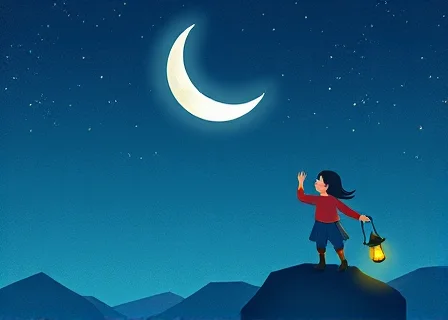
One evening, a curious child named Luna climbed the tallest mountain in the world. She carried nothing but a small lantern and a heart full of questions. "Why do you always stay the same?" she called up to the sky. "Don't you ever want to be part of the changing world?"
The Moon heard her and felt something stir within her—a yearning so deep it cracked her perfect surface. That night, she whispered to the Weaver of Light, who rested among the clouds. "I want to change," the Moon said. "I want to grow and shrink and transform like everything below me. I want to tell stories with my shape."
The Weaver smiled but warned, "Change is not without cost, dear Moon. You will never be whole forever. There will be nights when you are nearly gone, when the darkness swallows you almost entirely. Are you certain?"
"Yes," the Moon answered without hesitation. "I would rather be changing and almost lost than perfect and alone."
And so the Weaver wove a new spell, threading time and shadow into the Moon's silver light. The next evening, the Moon felt herself growing smaller—a tiny sliver of her former self. But instead of sadness, she felt joy, for the people below looked up and gasped. Children pointed and laughed with delight. Lovers held hands beneath her crescent curve. Farmers read her phases like a calendar, planting by her waxing glow and harvesting by her waning light.
Each night, the Moon transformed. She grew from a thin whisper to a bold circle and back again, telling a different story with every shape. The crescent was her laughing, the half-moon was her listening, the full moon was her singing. And on the nights when she disappeared entirely, she was not gone—she was simply resting, gathering new stories to tell.
The tides felt her changes and learned to rise and fall in sympathy. Wolves howled her phases to the stars. Poets wrote verses about her moods. And Luna, the child who had asked the first question, grew old telling everyone who would listen: "The Moon changes because she chose to. She chose to be part of us."
And to this day, she keeps her promise—forever shifting, forever returning, forever telling the world that nothing beautiful stays the same.