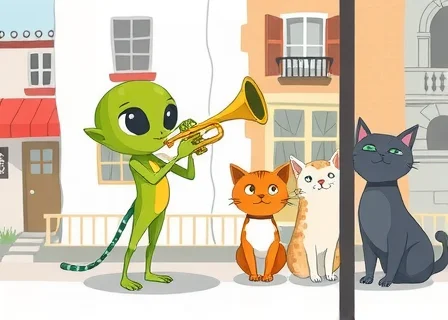
The Alien Who Wanted to Be a Street Musician
# The Alien Who Wanted to Be a Street Musician
In a galaxy far beyond the shimmering rim of the Andromeda spiral, there lived a small green alien named Zorblet. Zorblet was unlike any of his fellow Zogonians. While others spent their days calculating hyperdrive trajectories and mining crystalline energy from dying stars, Zorblet dreamed of something entirely different. He dreamed of music.
Not the mathematical harmonics that Zogonians used to communicate across light-years, but real, earthy, soulful music—the kind that made hearts flutter and feet tap and strangers smile at each other on crowded street corners.
"I want to be a street musician," Zorblet announced one evening at the family pod, his three antennae quivering with nervous excitement.
His mother dropped her quantum wrench. His father's holographic newspaper flickered and died. "A street musician?" his father gasped. "But Zorblet, you're from the prestigious Glarbon family! We're engineers! Scientists! Not... not buskers!"
But Zorblet's mind was made. He had listened secretly to Earth broadcasts for years, captivated by the saxophonists in smoky New Orleans clubs, the guitarists on Barcelona's Las Ramblas, the violinists in Vienna's cobbleled squares. Something stirred in his chest—a feeling the Zogonians had no word for.
So one night, under the cover of two shimmering moons, Zorblet packed his small ship with his most treasured possession: a vintage saxophone he had traded three months' rations for from a passing merchant vessel. He set his coordinates for Earth, for a bustling city called Paris, where art and music flowed like the river Seine.
When Zorblet arrived, he was terrified. His green skin gleamed under the streetlights. His large black eyes reflected the passing crowds. He stood on a corner near Montmartre, clutching his saxophone, watching humans rush by with their earbuds and coffee cups and important destinations.
No one noticed him. No one cared.
Days turned into weeks. Zorblet played until his fingers ached and his lungs burned. He played jazz standards and blues melodies and songs he made up himself, pouring his loneliness and hope and dreams into every note. Some people dropped coins. Most walked past. Children pointed and laughed. Adults pretended not to see.
But then, one rainy Tuesday evening, something magical happened.
An old man with a weathered face and kind eyes stopped to listen. He stood there through an entire song, rain dripping from his woolen hat. When Zorblet finished, the man smiled. "That was beautiful," he said softly. "You play like you have a story to tell."
Zorblet's antennae trembled. "I do," he replied. "I'm from very far away."
The old man laughed, thinking it was a joke. But he dropped a whole euro into Zorblet's case and stayed to listen to another song. Then another person stopped. Then a young couple. Then a group of tourists.
Word spread through the neighborhood about the green street musician who played like an angel from another world. People came from all over Paris to hear him. Some threw roses. Others recorded videos that went viral across the internet.
Zorblet never became rich or famous beyond the city limits. But he didn't need to. Every evening, he stood on his corner in Montmartre, playing his saxophone as the sun set over the rooftops, surrounded by smiling faces and clapping hands.
He had found what he was searching for—not fortune or glory, but connection. Through music, a little green alien from the stars had touched human hearts, and in doing so, had finally found his home.
And somewhere in the Zogonian galaxy, his father watched a grainy video on a smuggled tablet and whispered to his wife, "Perhaps... perhaps our son is onto something."