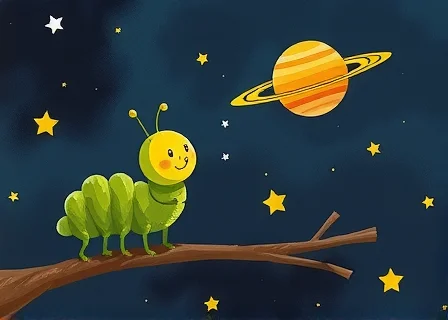
The Caterpillar Who Dreamed of Space
# The Caterpillar Who Dreamed of Space
In a garden where moonlight pooled like silver honey and flowers hummed lullabies to the sleeping earth, there lived a caterpillar named Cosmo. While other caterpillars spent their days munching contentedly on clover and debating the merits of various leaves, Cosmo spent his nights gazing upward, his tiny eyes reflecting the infinite tapestry of stars.
"You're wasting your time," chided Clover, his best friend, munching enthusiastically on a dandelion leaf. "Those lights are just fireflies that got lost. Nothing good up there but empty darkness."
But Cosmo knew better. Every night, he felt a strange pulling in his heart, as if the stars were singing songs written just for him. He dreamed of drifting through cosmic gardens where nebulae bloomed in colors no earthbound flower could imagine, where comets trailed stardust like bridal veils, and where planets spun in perfect, silent dances.
The other garden creatures laughed. The butterflies, proud of their newly grown wings, fluttered dismissively above him. "We can fly," they chimed, "and even we stay in the garden. You, who crawl on velvet belly, dream of touching the sky? Preposterous!"
Yet Cosmo continued his nightly vigil. He studied the moon's phases, memorized constellation patterns, and whispered his dreams to the wind, hoping it might carry them upward.
One autumn evening, as the first frost kissed the garden, an ancient owl landed beside Cosmo. Her feathers were the color of midnight, and her eyes held the wisdom of a thousand seasons.
"Little dreamer," she hooted softly, "I have watched you many nights. Your dreams are not small, though you are."
"Is it foolish?" Cosmo asked, his voice barely a whisper. "To want what I can never reach?"
The owl tilted her head. "Tell me, young one—what is a caterpillar before it becomes a butterfly?"
"Crawling earthbound," Cosmo replied.
"And after?"
"Free. Able to touch the sky."
The owl's eyes gleamed. "Transformation is magic's oldest language. But not all transformations are the same. Some creatures grow wings of flesh. Others grow wings of purpose."
She reached into her feathers and pulled out a single star-shaped seed, glowing faintly blue. "This fell from the cosmos long ago. It has waited for a dreamer worthy enough to plant it."
Cosmo's heart trembled as he accepted the gift. "What do I do?"
"Plant it in your heart," the owl instructed. "Water it with belief. Tend it with patience."
That night, Cosmo did as instructed. He closed his eyes and imagined the seed taking root, sending luminous threads through his tiny body. He dreamed not of becoming something else, but of becoming more himself.
When morning came, Cosmo awoke different. He had not grown wings. He had not transformed into a butterfly. But when he looked up, he saw the garden with new eyes—every dewdrop reflecting galaxies, every spiderweb tracing orbital paths, every flower a living star.
And then, something extraordinary happened. Cosmo began to float. Not like a butterfly flies, flapping against gravity's pull, but like a leaf caught in an upward current, gentle and inevitable. He rose above the clover, above the flowers, above the tallest oak, his body shimmering with starlight.
The garden creatures watched in wonder as Cosmo ascended, not with wings, but with dreams made manifest. He had discovered the oldest magic of all: that those who dream truly enough become their dreams, and that the distance between earth and stars is measured not in miles, but in belief.
Cosmo drifted into the cosmos he had always loved, finally home among the infinite gardens of space, where caterpillars with star-seeds in their hearts become constellations, guiding other dreamers who dare to look up.