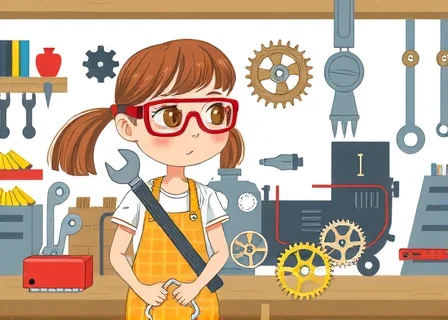
The Cinderella Who Was a Great Engineer
Once upon a time, in a kingdom where steam and sorcery intertwined, there lived a young woman named Ella who possessed not a glass slipper, but a brilliant mind for engineering. Her mother, a renowned artificer before her passing, had taught Ella the secrets of gears, pulleys, and enchantments that powered the kingdom's greatest machines.
After her father's death, Ella's stepmother and two vain stepsisters seized control of the household. They forced her to labor in the soot-filled workshop, tending to broken contraptions while they squandered the family fortune on frivolous luxuries. Yet Ella never complained. In the flickering light of forge and candle, she designed marvels that would have made any royal engineer weep with wonder.
One day, an invitation arrived: the Prince was hosting a Grand Exhibition to find a spouse who could solve the kingdom's greatest challenge—the Water Clock of Ages had stopped, and with it, the magical flow of time itself threatened to freeze forever.
"Perhaps one of you might impress the Prince," Ella suggested to her stepsisters as they preened before their mirrors.
They sneered. "You belong among the gears and grease, Cinder-Ella," they mocked, before departing in their finest silks.
That evening, Ella's fairy godmother appeared—not with a wand, but with a engineer's compass. "Child, I see the blueprints in your soul. Let us bring them to life."
With a swirl of her cloak, she transformed Ella's work clothes into a gown woven with copper thread and illuminated by tiny luminescent crystals. Instead of a pumpkin coach, she conjured a magnificent steam-carriage powered by Ella's own design—a clean-burning aether engine that left no smoke, only sparkles.
"Remember," her godmother warned, "the enchantment lasts until midnight, when the aether core must recharge."
At the palace, nobles marveled at intricate displays, yet none could approach the broken Water Clock. The royal engineers had failed. The Prince stood discouraged beside the great mechanism, its crystalline gears motionless.
Ella approached, her eyes alight with understanding. "May I?"
The Prince gestured helplessly. Ella examined the clock, her fingers tracing ancient runes etched into brass. "It's not broken," she declared. "It's misunderstood. The original engineer designed it to respond not to force, but to harmony."
She requested tools and set to work. While courtiers whispered, Ella adjusted tension springs, realigned planetary gears, and sang a melody her mother once taught her—a song of turning wheels and flowing water. One by one, the crystals glowed. The great clock shuddered, then began to turn. Water cascaded through transparent pipes. Time flowed once more.
The Prince was enchanted, not by beauty alone, but by brilliance. "Who are you?"
"An engineer," Ella replied simply.
But midnight struck. Ella fled, leaving behind not a slipper, but a small brass gear inscribed with her initials. The Prince searched the kingdom until he found its match in Ella's workshop.
They married and ruled together, building schools where children learned both magic and mechanics. And Ella, the Cinderella who was a great engineer, proved that the most powerful enchantment of all was a curious mind refusing to be dimmed.