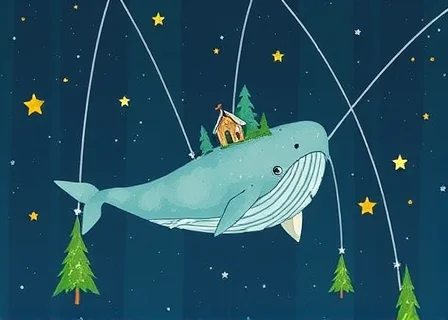
The Space Whale Who Carried a Forest
In the velvet darkness between stars, where nebulas bloom like cosmic flowers, swam Astraeus, the Space Whale. His skin shimmered with constellations, each freckle a distant sun, and his great tail stirred the stardust into swirling galaxies. But what made Astraeus truly miraculous was not his celestial nature—it was the forest he carried upon his back.
This was no ordinary woodland. The Celestial Forest had taken root in the curved valley of Astraeus's spine centuries ago, when a wandering seed from the Tree of Life had drifted through the cosmos and found purchase in the whale's mossy skin. Now, towering silver-barked trees stretched their branches toward the infinite, their leaves glowing with soft bioluminescence. Crystal rivers wound between roots that sparkled like diamonds, and creatures of pure light danced among the branches—foxes with tails of comet fire, birds whose songs were made of starlight, and deer whose antlers bloomed with tiny moons.
Astraeus had swum through the universe for eons, a living ark preserving the last fragments of worlds that had died. He visited dying stars to warm the forest during cold cosmic nights, and he dipped his great body through asteroid belts where mineral-rich dust nourished the trees. The forest creatures knew no fear, for they had never known predators. They existed in eternal harmony, sustained by the whale's gentle movements through space.
One day, as Astraeus glided past a crumbling planet called Aetherea, he sensed something extraordinary—a single pulse of life from the barren world below. The planet had been dead for millennia, its atmosphere long scattered to the solar winds, yet something called to him. With a rumble that vibrated through his bones and into the forest, Astraeus descended.
The forest creatures sensed his purpose. The light-deer bowed their heads, and the comet-foxes curled protectively around the saplings. They understood that their whale was about to perform an act of cosmic generosity.
Astraeus positioned himself above Aetherea's largest continent and began to sing. His song was not sound but vibration—a frequency that shook loose the seeds, spores, and creatures of the Celestial Forest. Like a gentle rain, they drifted down through the thin atmosphere: glowing seeds that would become trees, tiny creatures that would multiply and evolve, spores that would create soil from barren rock.
The forest on his back diminished. The silver trees became sparse, the crystal rivers ran shallow, and the light-creatures grew dim. But Astraeus sang on, his voice carrying the promise of rebirth.
When the last seed had fallen, Aetherea began to change. The seeds took root in the ancient soil, and within hours—accelerated by their cosmic nature—saplings burst forth. The light-creatures spread across the world, their bioluminescence igniting the darkness. Within days, Aetherea breathed again.
Astraeus, now bare-backed but content, turned toward the stars. He would find another seed, another forest, another world to save. For he was the Space Whale, and his purpose was written in the language of life itself: to carry, to nurture, to give.
And somewhere in the cosmos, a new seed drifted, waiting to find home upon his back.